 Axolotl Den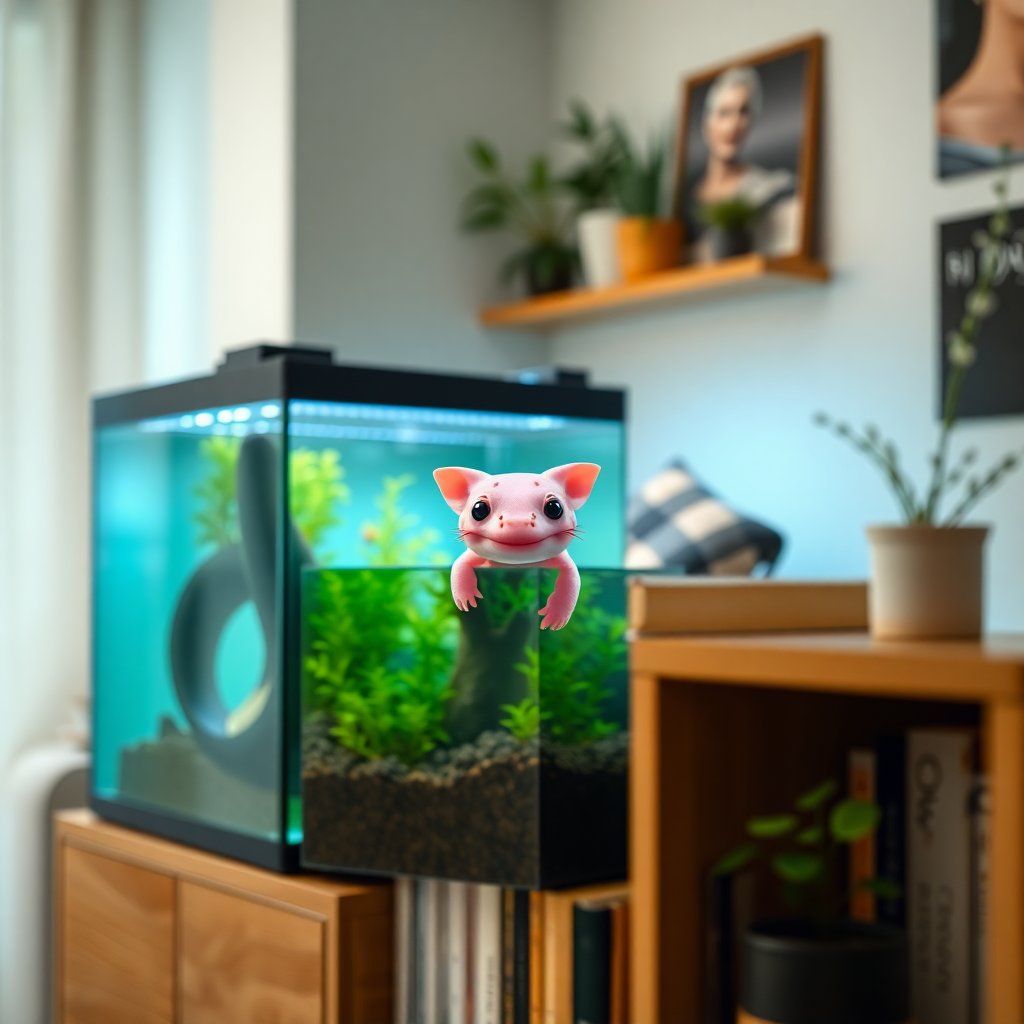
If you live in an apartment and you've been thinking about a pet, you've probably already ruled out dogs (noise, space, walks, most buildings require approval). Maybe cats too (some buildings don't allow them, and you're away 10 hours a day). Regular fish feel too passive — you end up staring at a tank and feeling vaguely like you're maintaining equipment, not connecting with a creature.
Axolotls hit a sweet spot that most people don't consider. And once you've had one, you'll understand why the hobby has been growing steadily for years.
They Take Up Almost No Space
A single adult axolotl needs a 20 gallon long tank — roughly 30 inches wide, 12 inches deep, 12 inches tall. That fits on a dresser, a sturdy bookshelf, or a dedicated aquarium stand that takes up less floor space than a nightstand. Two axolotls need a 40 gallon breeder, still very manageable in a studio or one-bedroom apartment.
Compare that to a dog (crate, bed, space to move, outdoor access) or even a cat (furniture to claim, space to run, litter box placement). Axolotls live in a contained environment that you control entirely, placed wherever it fits your apartment.
→ Shop 20-gallon long aquariums on Amazon
They're Completely Quiet
Zero noise. No barking, no meowing, no squeaking wheels. The only sound in the room is the gentle hum of the air pump — which, once you've lived with it for a day, fades into background ambiance. Many axolotl owners describe it as soothing white noise.
If you have thin walls, a building with noise policies, or just value a quiet environment, this matters enormously. You could have an axolotl in a studio apartment with paper-thin walls and your neighbor would never know.
No Walking, No Grooming, No Shedding
Walking schedule: None. Grooming appointments: None. Fur on furniture: None. Pet sitter for weekend trips: Optional (axolotls are fine for 3–4 days without feeding).
The maintenance routine for an axolotl is:
- Feed 3–4 times per week (adults) — 5 minutes
- Weekly partial water change (25–30%) — 20 minutes
- Clean the sponge filter monthly — 10 minutes
- Check temperature and do a quick parameter test weekly — 5 minutes
Total time investment: maybe 2–3 hours per month for a single adult axolotl in a healthy, established tank. That's less maintenance than a potted plant that needs daily watering.
The Setup Cost Is Reasonable
Yes, there's an upfront investment. But compared to a dog (first year cost often $1,000–3,000 including food, vet, supplies, crate, etc.) or a cat ($600–1,500 first year), axolotl setup is modest.
Complete setup for one axolotl:
| Item | Cost | |---|---| | 20-gallon long tank | $50–80 | | Hang-on-back or sponge filter | $15–35 | | Thermometer (digital) | $10–15 | | Water conditioner (Seachem Prime) | $10 | | Substrate (sand or bare bottom) | $10–20 | | Hides (terra cotta pots, PVC) | $5–15 | | Liquid test kit (API Master) | $25 | | Food (first supply) | $15–20 | | Total | ~$140–215 |
After that, ongoing costs are minimal: $5–10/month for food, occasional filter media replacement, water conditioner.
→ Shop complete axolotl starter kits on Amazon
They're Shockingly Captivating to Watch
This is the part that surprises people, especially those used to fish. Axolotls seem like they should be boring — they mostly sit still at the bottom — but they're not. They have distinct personalities that emerge over time. They'll swim to the front of the tank when you approach at feeding time. They'll rearrange their hides. They'll yawn (it's exactly as delightful as you'd imagine). They'll stare at you with small, expressive eyes that feel oddly deliberate.
Their external gills are mesmerizing — they sway and move with water currents and the axolotl's breathing. Their tiny legs are comically expressive. They're the most prehistoric-looking creature you can legally keep in an apartment, and watching them for 10 minutes after a long day is genuinely restorative.
The combination of alien appearance and real personality is what hooks people. You expect an aquarium. You get a connection with a creature that clearly notices you.
They Don't Mind If You Work Long Hours
Unlike dogs, axolotls don't experience separation anxiety. They don't pace, bark, destroy things, or become depressed when you're gone for 10 hours. They're adapted to a life of sitting on the cold substrate of a lake, waiting for prey to drift by. A full workday is nothing to them.
A long weekend away? Fill the tank with food automations (timed feeders exist, though they're optional for 2–3 day trips) and they'll be fine. Unlike a cat or dog, you're not burdening friends or paying for sitters every time you travel.
→ Shop automatic fish feeders for axolotl tanks on Amazon
Most Buildings That Ban Dogs Allow Axolotls
Axolotls are aquatic animals in a sealed tank — they're legally more similar to fish than to dogs or cats in most lease agreements. If your building bans dogs and cats, it typically won't have any restriction on axolotls. Always check your specific lease, but in practice, the vast majority of apartment dwellers who want axolotls face no restrictions.
This is a genuine advantage for renters who've been pet-restricted for years.
The Setup Is Less Intimidating Than It Looks
The one part that gives new owners pause: the nitrogen cycle. Before you bring an axolotl home, your tank needs to run for 4–6 weeks to establish the beneficial bacteria that process waste. This sounds complicated, but in practice it involves filling the tank, running the filter, adding a small ammonia source, and testing every few days.
Once the tank is cycled, maintenance is genuinely simple: feed, water change, check parameters. A stable axolotl tank basically runs itself. See our cycling guide for the complete walkthrough.
Honest Caveats
They can't be handled frequently. Axolotls have permeable skin that absorbs chemicals from your hands. Frequent handling stresses them. You can interact with them by letting them swim onto your hand inside the tank briefly, but they're not lap animals. If you want something to hold and cuddle, a dog is a better choice.
They need cold water. The 60–68°F temperature requirement means monitoring during summer. In warm apartments, a small fan over the tank surface provides evaporative cooling. In very hot climates, a small aquarium chiller may be necessary. This is the most demanding part of axolotl care in warm environments.
The initial setup requires patience. Waiting 4–6 weeks for the tank to cycle is the hardest part. It's not labor-intensive — it just requires not rushing.
Equipment Shopping List
Everything you need for a complete, comfortable apartment axolotl setup:
→ Shop 20-gallon long tank on Amazon
→ Shop sponge filter for axolotl on Amazon
→ Shop API Master Test Kit on Amazon
→ Shop Seachem Prime water conditioner on Amazon
FAQ
What does an axolotl eat? Primarily earthworms (nightcrawlers), frozen bloodworms, and sinking carnivore pellets (Hikari brand). Fed 3–4 times per week as adults. See our complete axolotl feeding guide for the full breakdown.
How long do axolotls live? 10–15 years in captivity with proper care. They're a long-term commitment — longer than most people expect for an "aquarium pet."
Can I keep two axolotls together? Yes, with the right setup. They need enough space (40 gallon minimum for two), multiple hides so each has its own territory, and roughly equal size to prevent nipping. See our hides guide for tank enrichment that makes co-habitation smoother.
Do axolotls interact with their owners? More than you'd expect. They recognize feeding patterns and frequently swim to greet you at the front of the tank. They're not dogs, but they're significantly more interactive than typical aquarium fish.
Is the smell an issue in an apartment? A healthy, well-maintained axolotl tank doesn't smell. The water should smell neutral — like clean, faintly earthy water. If there's an unpleasant smell, it indicates water quality issues (decomposing food, ammonia spikes) that need to be addressed. Proper filtration and weekly water changes keep tanks odor-free.
As an Amazon Associate we earn from qualifying purchases. This article contains affiliate links; if you buy through them we may earn a small commission at no additional cost to you.