 Axolotl Den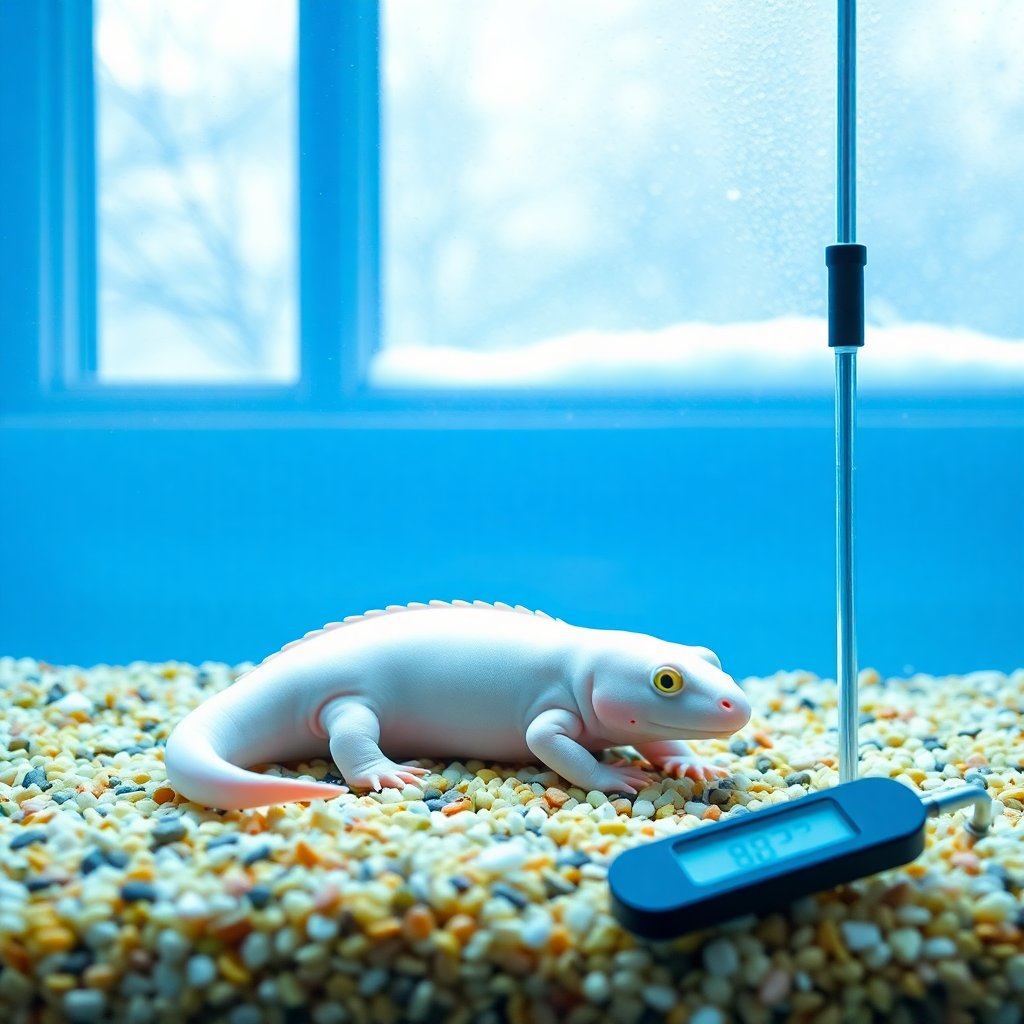
Almost every axolotl temperature guide you will find was written to solve one problem: summer heat. Chillers, fans, frozen water bottles, and cool rooms all exist because warm water is the fastest way to kill a cold-water salamander. But as fall turns to winter, a quieter and less-discussed problem shows up in cold apartments, drafty old houses, and unheated basements — the tank getting too cold, or worse, swinging up and down every time the furnace cycles.
This guide covers the cold end of the dial: how low is safe, when a heater is actually worth adding, the subtle signs your axolotl is chilled rather than sick, and how to keep a winter tank stable without cooking your animal the moment spring arrives.
This is general keeper-to-keeper information, not medical advice. If your axolotl looks genuinely ill, talk to an exotics vet who treats amphibians.
The safe range, and why cold is the lesser danger
Axolotls do best in water between roughly 60 and 64°F (16 to 18°C), and most experienced keepers treat about 64°F as the sweet spot. That target does not change in winter. What changes is which direction your room is pushing the tank.
Here is the reassuring part: axolotls tolerate cold far better than heat. These are cold-water amphibians from high-altitude Mexican lakes, and their whole physiology is built for chilly conditions. Water in the mid-50s Fahrenheit will not harm a healthy axolotl the way water in the mid-70s quickly does. Cooler water actually slows the progression of disease and can even speed wound healing, which is exactly why keepers deliberately cool sick animals — a technique covered in our axolotl temperature requirements and chiller guide.
So a slightly cold tank is rarely an emergency. The real winter problems are three: water cold enough to stop digestion, temperatures that swing rapidly, and keepers who overcorrect with a heater and swing the tank the other way.
How cold is too cold
Think of winter temperatures in three bands.
60 to 64°F — ideal. No action needed. If your home naturally sits here in winter, you are done.
55 to 60°F — safe but slow. Your axolotl is fine, but its metabolism has downshifted. It will move less, hide more, and want less food. This is normal seasonal behavior, not illness.
Below 55°F — digestion stalls. This is the number that matters. Once water drops under about 55°F (13°C), an axolotl's gut slows to the point where food can sit undigested and cause bloating or gas. Sustained temperatures below 50°F (10°C) push into genuinely stressful territory for a long-term home setup, even though these animals can survive brief dips lower.
The practical rule: keeping the tank above roughly 55°F all winter keeps digestion working. Aquarium care resources such as the long-running amphibian community at Caudata.org consistently point to the low-60s as the target and treat sustained sub-50°F water as something to correct, not ignore.
The bigger issue is what happens after you feed. A cold, sluggish axolotl still eats if you offer food, but its gut cannot process it. If your winter tank runs cold, feed less often and watch for bloating. When an animal that normally eats well suddenly refuses food as the room cools, temperature is usually the reason — our guide on what to do when an axolotl stops eating walks through separating a cold-slowed appetite from a real health problem.
Do axolotls need a heater in winter?
For most keepers, no. This surprises people, because the word "heater" is reflexively associated with fish tanks. But most homes stay warm enough through winter that an axolotl tank never drops into the danger zone, and adding a standard aquarium heater is one of the most common ways beginners accidentally overheat and kill an axolotl.
You genuinely need a heater only in specific situations:
- Your room regularly drops below about 55°F for long stretches — think an unheated garage, a cabin, or a poorly insulated basement in a cold climate.
- You leave for extended winter travel and the home heat is turned way down or off.
- Your tank sits against an exterior wall or single-pane window that gets bitterly cold overnight.
If one of those applies, do not reach for a standard 100-watt tropical heater. Use the smallest wattage you can find with an adjustable thermostat, set it to the minimum — around 60°F, never the 75°F-plus that fish heaters default to. The heater is there as a floor to prevent extreme cold, not to warm the water to tropical levels. A low-wattage adjustable model paired with a separate temperature controller is the safest arrangement.
→ Shop adjustable low-wattage aquarium heaters on Amazon
For real peace of mind, put any heater on an external controller rather than trusting the heater's built-in dial, which is often off by several degrees. A plug-in controller cuts power to the heater once the water hits your set point, so a stuck thermostat cannot cook the tank.
→ Shop plug-in aquarium temperature controllers on Amazon
The real winter enemy: temperature swings
A steady 57°F tank is far healthier than one that bounces between 52°F at 3 a.m. and 68°F in the afternoon. Rapid swings stress an animal whose entire biology is tuned to a stable, cool environment, and winter is prime swing season because home heating cycles on and off all day.
Common winter swing sources:
- A tank near a heating vent or radiator. The tank warms every time the furnace runs and cools between cycles.
- A tank against a cold window. Overnight the glass radiates heat away, then daytime sun or room heat warms it back up.
- Space heaters in the room, which create dramatic local temperature spikes.
The fix is mostly free: move the tank away from vents, radiators, exterior windows, and any space heater. An interior wall in a room with steady, moderate heat is ideal. A lid and even a wrap of insulation on the back and sides can buffer overnight dips in a cold room.
You cannot manage swings you cannot see, which makes a reliable thermometer the single most important winter tool. A cheap stick-on strip is not enough — get a digital thermometer with a submerged probe and check it at different times of day, especially overnight lows.
→ Shop digital aquarium thermometers with probe on Amazon
Reading the signs of a chilled axolotl
Cold stress is subtler than heat stress, which is part of why it gets missed. An overheated axolotl shows obvious distress — curled gills, frantic movement, gulping at the surface. A cold axolotl mostly just goes quiet.
Watch for this cluster together:
- Very little movement and long stretches parked in one spot or hiding all day.
- Reduced or refused feeding, or food that seems to sit in the gut.
- Pale gills with reduced fluffiness (cold slows circulation).
- General lethargy that lifts once the water warms back toward the low 60s.
Any one of these alone can mean many things. Seen together in a tank you know is running cold, they point to temperature. The good news is cold stress is usually reversible: raise the tank slowly back into the 60 to 64°F range over a day or two — never with a sudden blast of warm water — and a chilled axolotl typically perks up, resumes eating, and returns to normal.
A simple winter routine
Keeping a tank safe through the cold months does not take much once it is dialed in. Fold these into your normal upkeep — our full tank maintenance schedule covers the rest.
- Check the thermometer daily, including at least one overnight low, for the first couple of weeks of cold weather to learn your tank's real range.
- Reposition the tank away from vents, windows, and space heaters before winter sets in.
- Adjust feeding to the temperature — if the water sits below 60°F, feed less often and watch for bloating.
- Add a controlled heat floor only if needed, using a low-wattage adjustable heater on an external controller set near 60°F.
- Avoid overcorrecting. A stable tank in the upper 50s beats a warm, swinging one every time.
Winter axolotl care really comes down to one mindset shift: stop treating cold as the enemy and start treating instability as the enemy. A cool, steady tank is exactly what these animals evolved for. Give them that, watch the thermometer, and adjust feeding to the season, and your axolotl will coast through winter with no drama at all.
Affiliate disclosure: Axolotl Den is reader-supported. Some links above are Amazon affiliate links, and we may earn a small commission on qualifying purchases at no extra cost to you. We only recommend gear we would use on our own tanks.
As an Amazon Associate we earn from qualifying purchases. This article contains affiliate links; if you buy through them we may earn a small commission at no additional cost to you.